
In the 1580s, Fray Diego de Soria, prior of the Augustinian convent of San Agustín at Acolman, outside Mexico City, asked for permission to do two unusual things. He wanted to say a run of special Masses from 16 to 24 December, and he wanted to say them outdoors, because his church was too small. Permission came, and the misas de aguinaldo, the gift Masses, began. They are the clearest precedent for what Filipinos now call Simbang Gabi.
Accounts differ on the year, 1586 or 1587, though both fall within the reign of Pope Sixtus V. They agree on the shape: nine days, ending on Christmas Eve, and a friar willing to move the Mass to where the people would actually fit. That willingness is, to our mind, the best way to read the four centuries that followed. The novena has been rescheduled, relocated and argued over many times since, and nearly every change was made to fit the people meant to attend.
Across the Pacific, on no known date
For two and a half centuries the Manila–Acapulco galleon trade tied Mexico to the Philippines, and the custom plausibly crossed the same route. Plausibly is as far as the record goes: none of the sources we read documents the actual transfer.
Nor is there a reliable arrival date. Retellings tend to fix on 1669, which no source we found supports; other accounts give 1668, and one says the 16th century. The evidence supports nothing more precise than the Spanish colonial period.
An hour set by the fields
Simbang Gabi means, literally, night worship: simba for going to Mass, gabi for night. Yet the traditional Masses are at dawn, with many parishes starting around four in the morning. The usual explanation is the farm day. Fr Julius De Sagun, rector of the Diocesan Shrine and Parish of Our Lady of Fatima in Binakayan, Kawit, Cavite, told GMA News in 2025 that the hour was meant “to give the farmers a chance to worship God at dawn just before they go to the fields to work during daytime”. Priests and columnists repeat that reason, but we found no colonial document confirming it.
Writing in The Philippine Star in 2005, the columnist Alejandro R. Roces described the rural custom of a band going round town an hour before the dawn Mass, playing villancicos, carols and “Ang Pasko Ay Sumapit”.
White in Advent, by permission
Advent is a season of waiting. Priests normally wear violet and the Gloria is left out. The dawn Simbang Gabi Masses have traditionally been an exception, granted by papal indult: white vestments and, as LiCAS.news puts it, the Gloria “is sung, which is otherwise forbidden the rest of the day because it is still the Advent season”. The readings are also their own. Fr De Sagun points out that the proper texts for 16 to 24 December “do not rotate yearly, unlike Sunday readings”.
The privilege was not always secure. According to LiCAS.news, the Masses were suspended for about a decade in the 1680s under Archbishop Felipe Pardo of Manila, after a Roman decree against vernacular singing during Mass, and resumed after his death. In 1953 the First Plenary Council of the Philippines petitioned Rome to keep the practice, and on 24 March 1961 Rome extended the indult for five years.
From the fields to the office
The largest change is the one most city parishioners now take for granted: the anticipated evening Mass, which lets you do the novena after work instead of before it. We could find no source that says when it became common. Our best guess is that it is the farmers’ logic applied to a different working day. A 4 a.m. Mass suited someone headed for the fields; a 7 p.m. Mass suits someone with an office and a commute.
Dioceses now permit it, but they have not settled what an evening Simbang Gabi is. Manila’s 2026 circular treats evening and dawn Masses alike, in white with the Gloria. Cebu’s 2025 guidance draws a line: the dawn Masses are the Misa de Gallo, the rooster’s Mass, in white; the evening ones are Simbang Gabi, in violet. “Put simply,” SunStar Cebu summarised in 2025, “Misa de Gallo refers to the traditional dawn celebrations of the novena, while Simbang Gabi refers to its evening observance, offered in the same preparation for Christmas but observed with distinct liturgical norms.” Fr De Sagun reads the names the other way: “Both Misa Aguinaldo and Misa de Gallo refer to the same nine Masses in preparation for Christmas. There is no liturgical difference — only a difference in meaning and emphasis.” In Spain, for what it adds to the confusion, the Misa del Gallo is the midnight Mass on Christmas Eve.
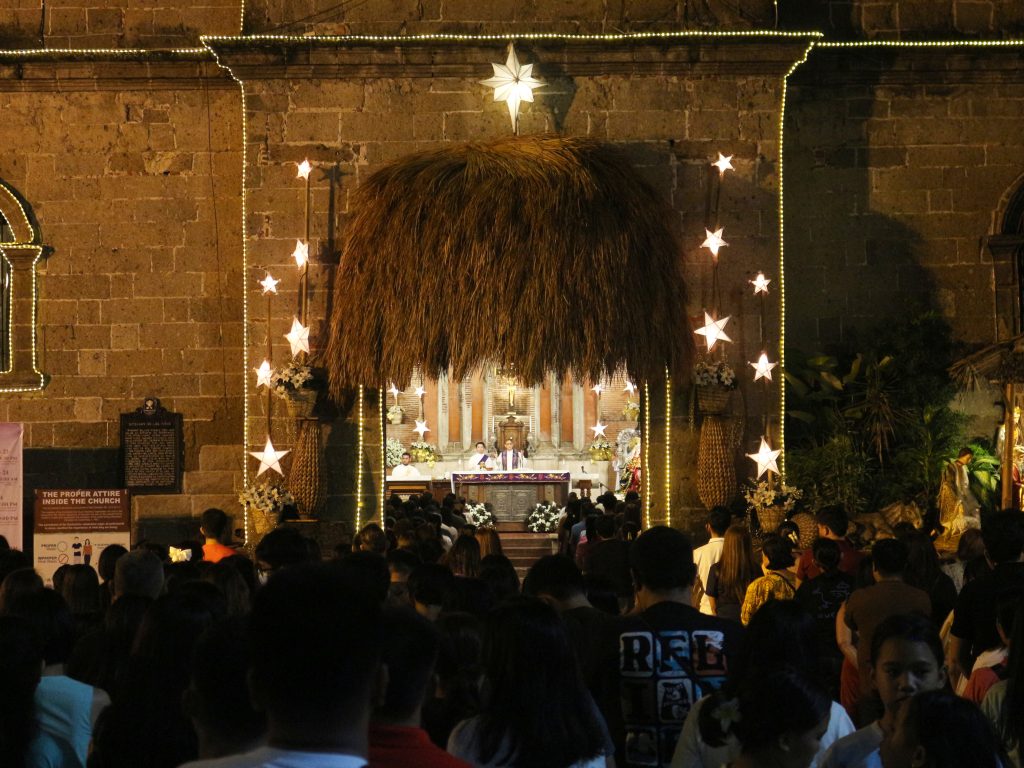
Archbishop Socrates Villegas of Lingayen-Dagupan addressed the hour question directly in The Philippine Star in 2023: “With focus on the essentials, let us remember that the most important component of Simbang Gabi is not the ‘time’ in which it is celebrated but the participation at ‘mass.’ The key word is ‘simba,’ not ‘gabi.’ The indispensable part of this nine-day pre-Christmas tradition is the Eucharist.”
San Francisco, then Phoenix
The next move was overseas, with Filipino emigrants. In San Francisco, Nellie Hizon received the Bene Merenti medal in 2011 for, in the words of the citation as reported by Positively Filipino, “institutionalizing the Simbang Gabi Commissioning Celebration in the Archdiocese of San Francisco in 2008, the first archdiocesan-wide celebration in the US”. Other accounts reportedly date San Francisco’s first Simbang Gabi earlier, so which one came first depends on what you count.
Phoenix is the newer case. According to The Catholic Sun, the Diocese of Phoenix held its first diocesan Simbang Gabi in 2024 at St Mary’s Basilica, drew a standing-room-only crowd, and moved the 2025 Mass to the larger St Paul Church. The diocese counts an estimated 10,000 Filipino Catholics and 19 priests of Filipino descent. Once again, the Mass moved to wherever there was room for the people.
What the nine days are for
One adaptation clergy have openly rejected: the belief that completing all nine Masses gets your wish granted. It is widespread. A Global Sisters Report columnist recalled that “it was a common belief that petitions and wishes would be granted when one completes the novena”. Clergy have said plainly that it is wrong.
“Completing the nine days of simbang gabi is not for their wishes to be granted. That is a wrong belief. That is not what going to the simbang gabi is for.”
Manila Auxiliary Bishop Broderick Pabillo, in The Philippine Star, 19 December 2016
The same report gives the purpose: “The nine days of praying is part of the preparation for the big feast of Christmas. For the formation of the faith and thanking God for His generosity.” Phoenix’s diocesan paper offers a popular devotional reading, that the nine days recall the nine months Mary carried Jesus. That is devotion, not doctrine, but it points the same way: towards Christmas, not towards a reward at the finish line.
Here is why we think the wish is different from every other change in this story. Acolman moved the Mass outdoors, the parishes moved it to dawn and then to the evening, and the emigrants took it to California and Arizona. Each of those changed the hour or the place and left the purpose alone. The wish changes the purpose. It turns nine days of preparation into nine payments towards a favour, and that is the part Bishop Pabillo said “should be explained in the masses in order to correct the people’s thinking”. People will probably keep making the wish anyway, which is what it means for a belief to be popular rather than official.
Outside the church gates
Vendors set up near parishes during the novena, selling two rice cakes in particular. Where the food custom came from is no clearer than the Masses: the Philippine Star food writer Dolly Dy-Zulueta says the origins of both cakes “cannot be pinned down” to one place.
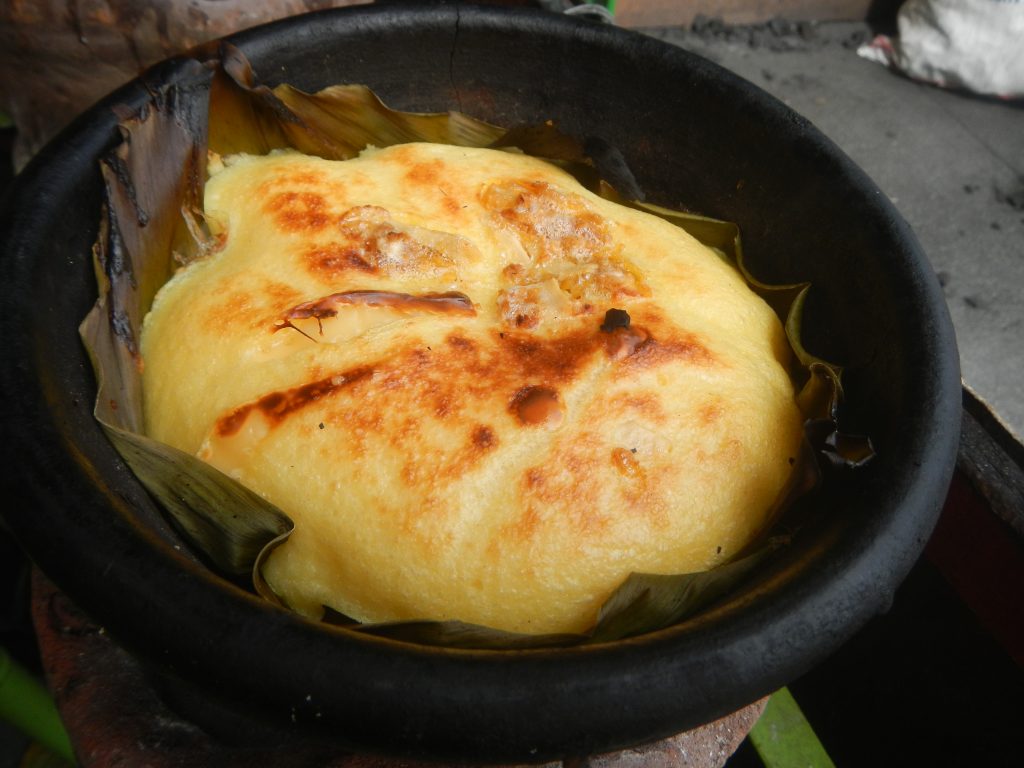
Bibingka is made from galapong, a batter of soaked and ground rice, poured into a clay pot lined with banana leaf and cooked over coals, traditionally with more coals on a lid above. It is topped with salted duck egg, kesong puti, grated coconut, butter or margarine and sugar. Similar cakes exist in eastern Indonesia, and linguists have not settled where the name comes from.
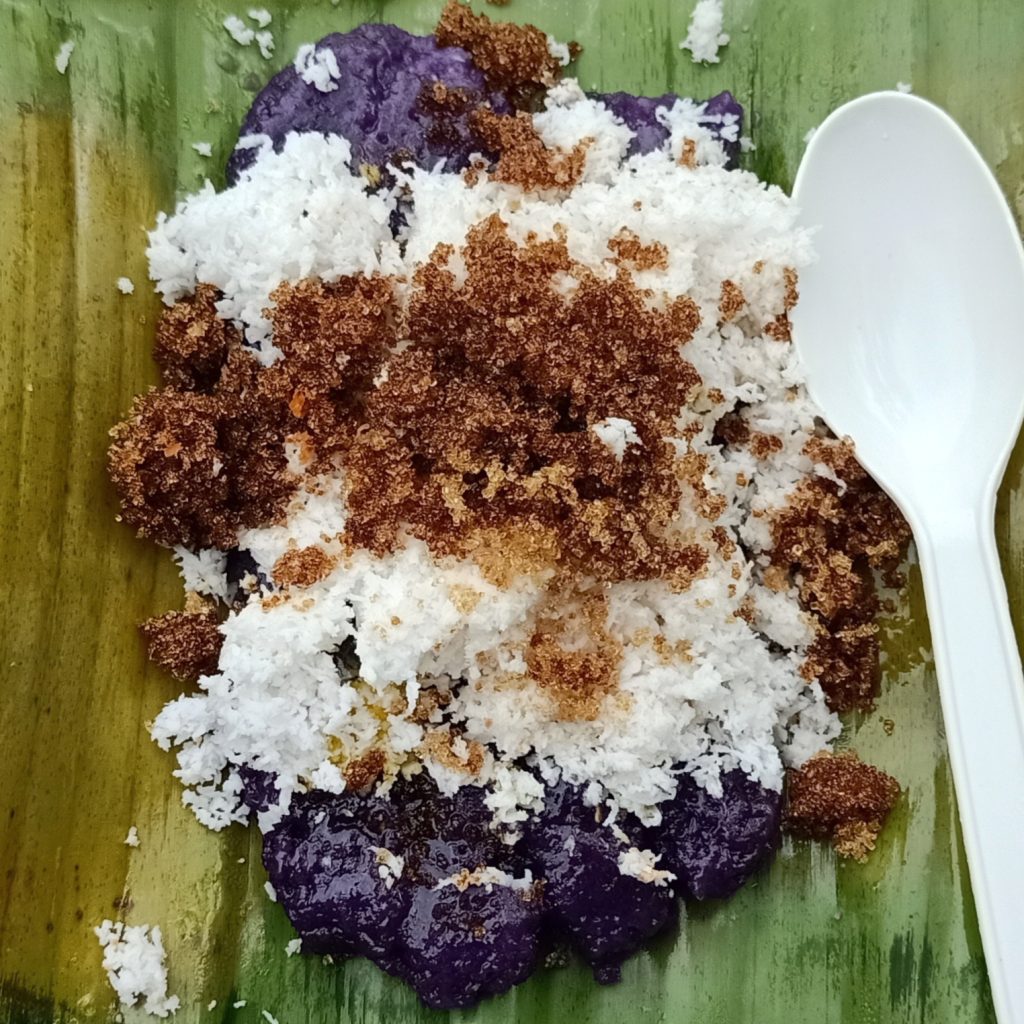
Puto bumbong is steamed upright in bamboo tubes, the bumbong of its name, then served on banana leaf with butter or margarine, grated coconut and muscovado sugar. Its purple traditionally comes from pirurutong, a purple glutinous rice, not ube. Pirurutong is scarce or expensive, though, and many stalls now tint ordinary glutinous rice with ube flavouring or food colouring. Newer “special” versions add cheese and condensed milk. Salabat, ginger tea, is often sold alongside.
Simbang Gabi 2026: dates and the local rules
Fray Diego would recognise one line in this year’s Manila circular: Masses outside recognised churches and chapels need the Archbishop’s explicit permission. The rest is below. Schedules vary by parish, so check your church’s page or noticeboard.
Simbang Gabi 2026 at a glance
Dawn Masses: Wednesday 16 to Thursday 24 December 2026. Anticipated evening Masses: from Tuesday 15 December. Sunday 20 December, the Fourth Sunday of Advent, falls inside the novena. Christmas Day is a Friday.
Archdiocese of Manila (circular of 12 November 2026, Cardinal Jose Advincula): evening Masses from 6 p.m.; dawn Masses start no later than 5:30 a.m.; weekday evening Masses may use the next day’s readings, but a Sunday evening Mass may not anticipate Monday, so check what your parish does on the evening of Sunday 20 December; white vestments and the Gloria at all Simbang Gabi Masses, Sundays included; the Creed on Sundays only. Ordinary Advent Sunday Masses stay in violet without the Gloria.
Archdiocese of Cebu (Commission on Worship guidance for December 2025; we have not seen a 2026 version): evening Simbang Gabi, 15 to 23 December, in violet, with no Gloria, no Christmas carols and no Misa Pastorella; dawn Misa de Gallo, 16 to 24 December, in white with the Gloria sung.
Elsewhere: your diocese may follow Manila, Cebu or neither. Ask the parish.
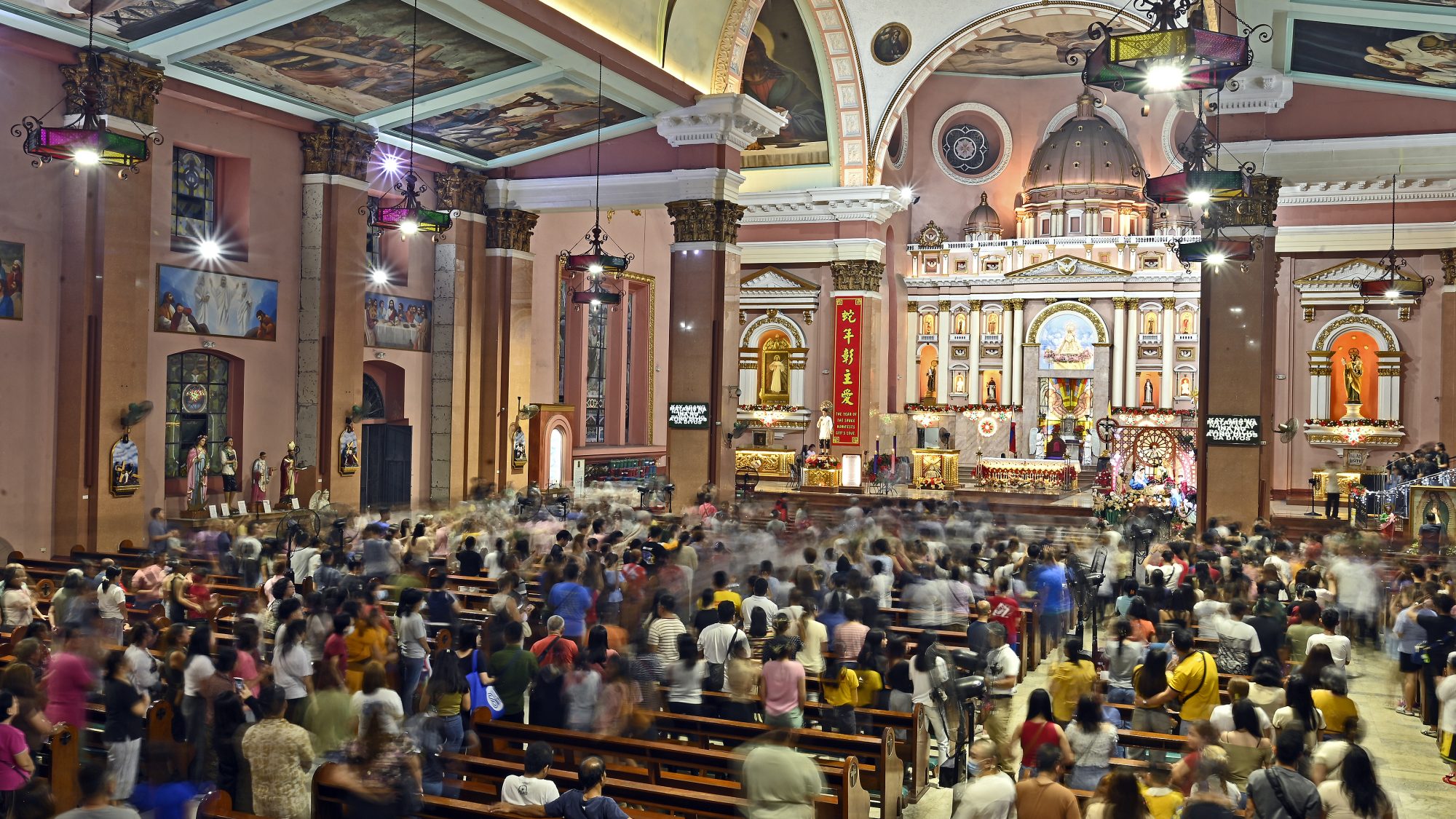
For a Simbang Gabi with history around it, Binondo Church, the Minor Basilica of San Lorenzo Ruiz pictured at the top of this story, is one option. Our walking guide to Binondo covers the rest of the neighbourhood.
Sources
- GMA News, “Manila Archbishop Advincula issues guidelines for Simbang Gabi 2026“; Interaksyon, “Manila archdiocese issues Simbang Gabi guidelines“, 17 November 2026
- SunStar Cebu, “Understanding the church’s guidance on Simbang Gabi, Misa de Gallo“, 17 December 2025
- GMA News, “Filipino spiritual tradition at Christmastime“, 18 December 2025
- The Philippine Star, “‘Simbang Gabi’ won’t grant wishes – Bishop“, 19 December 2016, and “Simbang Gabi: It’s the mass, not the time“, 15 December 2023
- LiCAS.news, “From ‘Misa de Gallo’ to ‘Simbang Gabi’“; Global Sisters Report, “Simbang Gabi novena strengthens faith of Filipinos“
- Alejandro R. Roces, “Misas de Aguinaldo“, The Philippine Star, 10 December 2005; Wikipedia, Las Posadas; Catholic News Agency, “How the ‘Posadas’ before Christmas in Mexico originated“
- GMA Entertainment, “What gives Puto Bumbong its color? No, it’s not Ube!“; Dolly Dy-Zulueta, “Where did Puto Bumbong come from?“, The Philippine Star, 24 December 2025; Wikipedia, Bibingka
- The Catholic Sun, “Simbang Gabi’s popularity prompts diocese to move Mass to larger venue“, 2 December 2025; Positively Filipino, “The Birth of Simbang Gabi in San Francisco“