
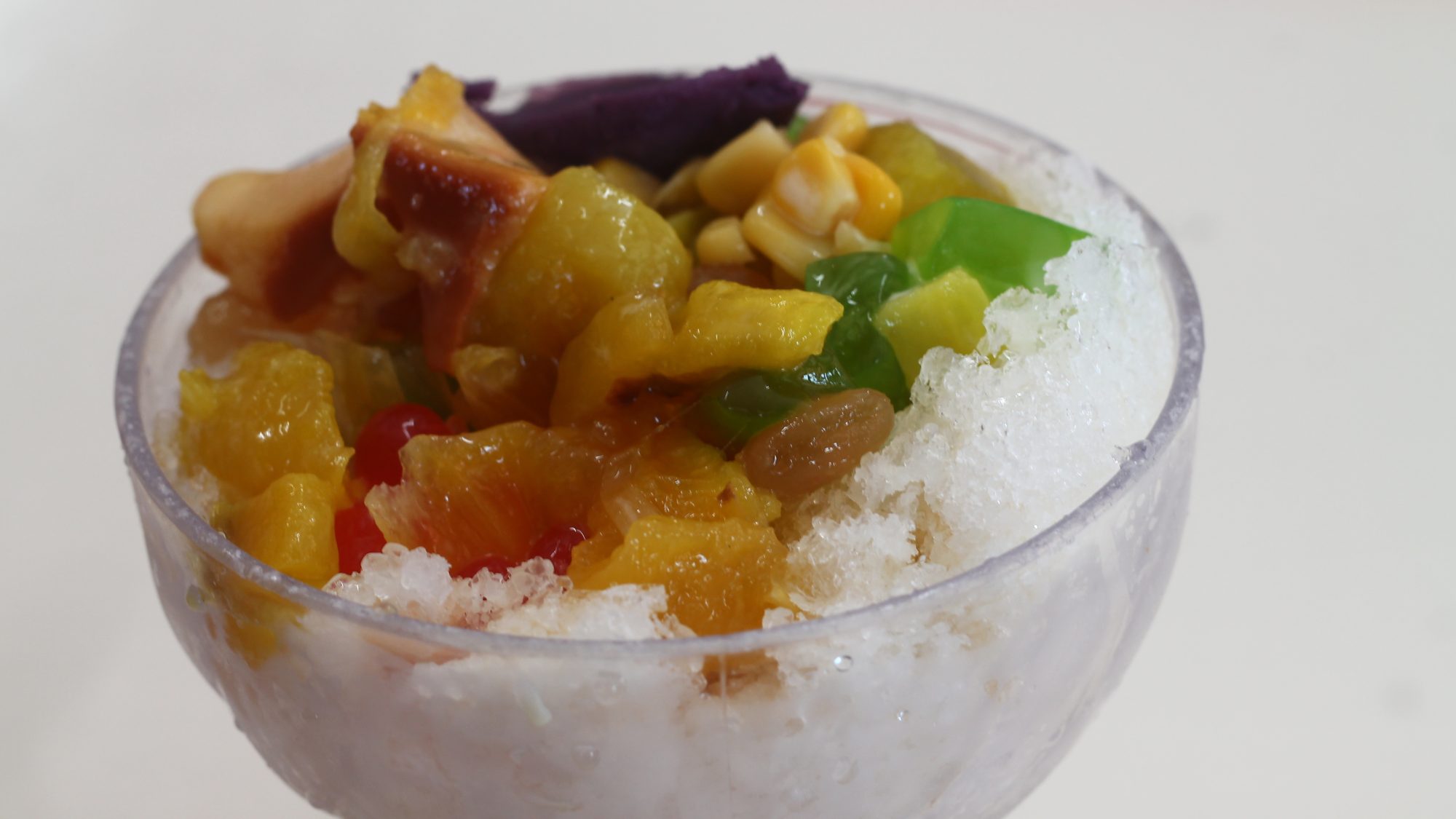
“What was sold for ten centavos,” Kiyoshi Osawa remembered, “was a plateful of cooked red beans heaped with ground ice, topped with sugar and milk.” Osawa, a Japanese resident of the prewar Philippines, was describing a trade the Japanese had to themselves, the shops “we Japanese called mongo-ya”. “The business could be started with a small capital outlay,” he added.
His memoir, A Japanese in the Philippines, came out in 1981, and the passage reaches us via the historian Ambeth Ocampo, who quoted it in the Philippine Daily Inquirer in 2012. For halo-halo history, it is the best primary evidence we found on where the dish came from, so it is worth being exact about what it shows. It shows a prewar Japanese precursor: beans in syrup on ice. It does not show who first called the dish halo-halo, or when, and nobody has documented an inventor. (The mongo in mongo-ya is munggo, the mung bean, which is green. In the Philippines it took the place of Japan’s red azuki.)
Shaved ice in Heian Japan, an ice plant on the Pasig
The idea is old. Ocampo traces Japanese shaved ice, kakigori, back about a thousand years to the Heian period, and quotes Sei Shōnagon’s Pillow Book, which lists “shaved ice mixed with liana syrup and served in a new silver bowl” among its “elegant things”.
Ice in Manila was the newer problem. Imported ice from the United States, Wenham Lake ice, had been reaching the Philippines since the mid-19th century, but in Ocampo’s words “the tropical Philippines did not have a regular supply of ice until the Americans built the Insular Ice Plant.” It went up in 1902 on the Pasig, near the southern end of the Puente Colgante, the bridge later replaced by Quezon Bridge, close to where the Metropolitan Theater and the Manila Post Office stand now. Its siren may even have entered the language: Ocampo, citing Nick Joaquin, links the phrase mabilis pa sa alas cuatro to the plant’s 4 p.m. siren.
The Japanese shops of prewar Manila
The people who would put beans on that ice were arriving at the same time. The historian Augusto V. de Viana counts 1,612 Japanese in Manila in 1918 and 3,984 in 1930. As early as 1914 there were “41 Japanese-owned bazaars, 21 trading firms and numerous small shops and refreshment parlors”, and about 250 Japanese establishments by the 1930s. Some Japanese immigrants worked as itinerant vendors selling ice cream cones and barquillos. His paper does not mention halo-halo or mongo-ya, but it gives a sense of the small trade Osawa was describing. The Michelin Guide dates the arrival of kakigori to Japanese migrants in the 1920s and 1930s.
Ocampo puts the sequence this way: “The origin of halo-halo can be traced to the prewar Japanese, who specialized in preserving beans like mongo, garbanzos, and kidney beans in a thick syrup. They then took the next step by serving these on crushed ice—a concoction that we have since indigenized into a Philippine version of the Japanese kakigori.” The early form went by mongo-ya or monggo con hielo.
Where it first sold is less certain. Quiapo’s Quinta Market, across the river from the ice plant, is often linked to it, and a walking-tour map calls that link local legend. The claim’s published source is an oral-history chapter in the 2006 book Quiapo: Heart of Manila, which says many informants in their forties and older “associate the Quinta Market with this dessert” and that “of all the city markets, the Quinta was closest to the ice.” That is a memory, not a record. Bicol has its own version. Amy Besa and Romy Dorotan’s Memories of Philippine Kitchens reports that, “according to the Bicolanos, the halo-halo started from the simple mongo con hielo” sold by Japanese-owned soda shops in Naga, Camarines Sur.
Sweets under the ice
The Filipino version grew by addition, as local ingredients joined the beans. More important, the sweets moved. “Philippine halo-halo has the condiments under ice while the Japanese version has the condiments over the ice,” Ocampo wrote. The Michelin Guide makes the practical case for that: with the sweets tucked below, it is easier to fold everything together with the milk and syrup.
The name describes that folding. Halò is the Filipino verb “to mix”, and the doubled form, usually translated “mix-mix”, means mixed together; the KWF dictionary’s prescribed spelling, according to Wikipedia, is halúhalò. Michelin reads the name two ways: “to mix and mix again, and to describe the joyful assortment of ingredients thrown together.” When the name first appeared is not documented.
Ocampo also argues that halo-halo and its Asian cousins, such as ais kacang and chè ba màu, share a root in kakigori, so that neither side copied the other. That is his interpretation; the shared history is not documented in detail.
1945
The war ended both halves of the arrangement. The Insular Ice Plant was wrecked in the Battle of Manila in 1945; its smokestack survived, and what remained was dismantled in the 1980s for the LRT-1 viaduct. Japanese residents who survived were interned and, in November 1945, ordered repatriated. “Following the Japanese evacuation after World War II,” Osawa wrote, “these mongo shops vanished entirely from the market scene.” The dish stayed. Some retellings, including a 2022 GMA segment, say the Japanese introduced shaved ice during the war. The evidence from Osawa, Ocampo and Michelin points to the years before it.
Milk cans in Bacoor, three ingredients in Pampanga
The regional versions come with family names attached. In Barangay Digman, Bacoor, Cavite, roadside stalls sell a full glass, the sandosenang sangkap or dozen-ingredient style. The City of Bacoor’s tourism pages, published in March 2026, say Original Digman Halo-Halo “was established by Nene Gonzales around the 1930s”, sold at first in repurposed evaporated-milk cans, and is now run by her son Boy Gonzales and his wife Minda. Another stall, BC2 Original Famous Digman Halo-Halo, dates itself, according to Bernard Cuevas, to 1969, when his mother Salud began selling by the roadside. More than one Digman stall uses the word “original”.
Pampanga went the other way, towards restraint. Razon’s of Guagua makes a three-ingredient halo-halo: sun-ripened saba, macapuno and leche flan with dayap (lime) rind, plus shaved ice and milk, and no added sugar. Its president and COO, Edwina Razon-Ayson, told the Daily Tribune in December 2025 that it began as a backyard business run by her three unmarried aunts in a Guagua subdivision, and explained the short list: add “sago and gulaman, the Halo-Halo becomes watery”. Her family’s Razon’s Food Corp. started in San Fernando in 2003 and opened its first Manila store in 2019; the Tribune‘s December 2025 pieces covered its reopening at SM Mall of Asia. Sources disagree on when the original began, so we are not printing a year. Several separate family businesses use the Razon name, so check which one you are buying from.
Kabigting’s of Arayat has its own three: mashed white beans, carabao’s-milk pastillas and sweet cream corn, with ultra-fine ice and carabao’s milk. The Philippine Star described it in 2003 as “whole sweet corn kernels, mashed white kidney beans” with “a spoonful of carabao’s milk jalea”. A property-portal feature updated in May 2026 says the Arayat original remains and lists branches from San Fernando to Quezon City; we could not confirm those through mainstream news.
What goes in a glass now
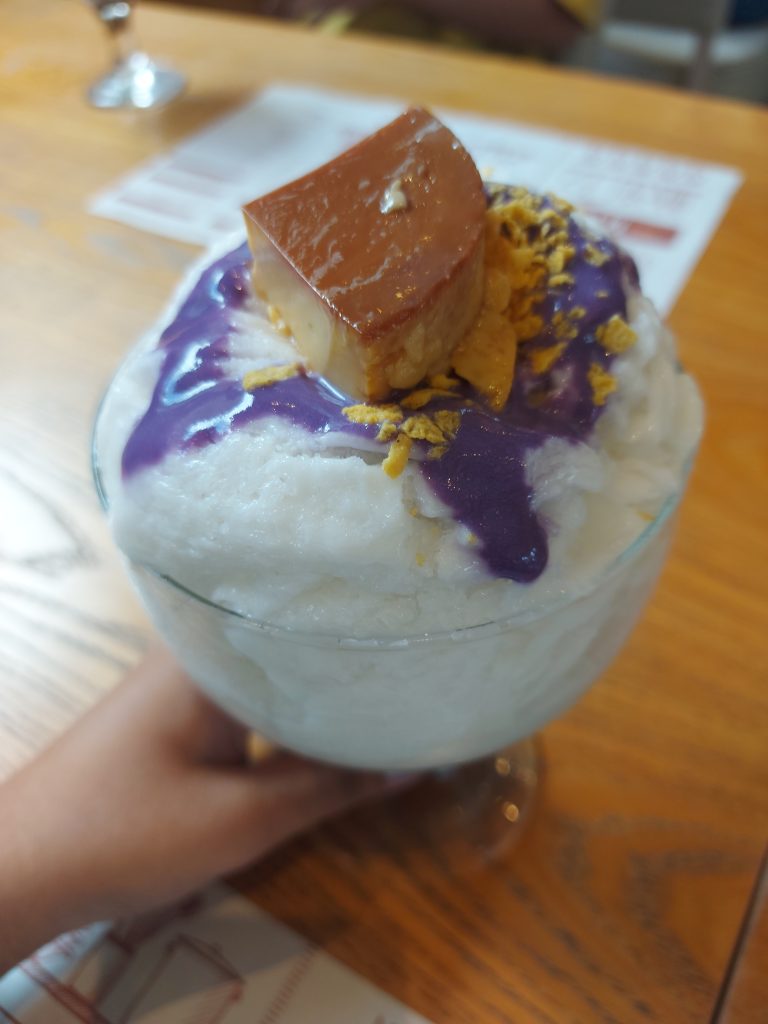
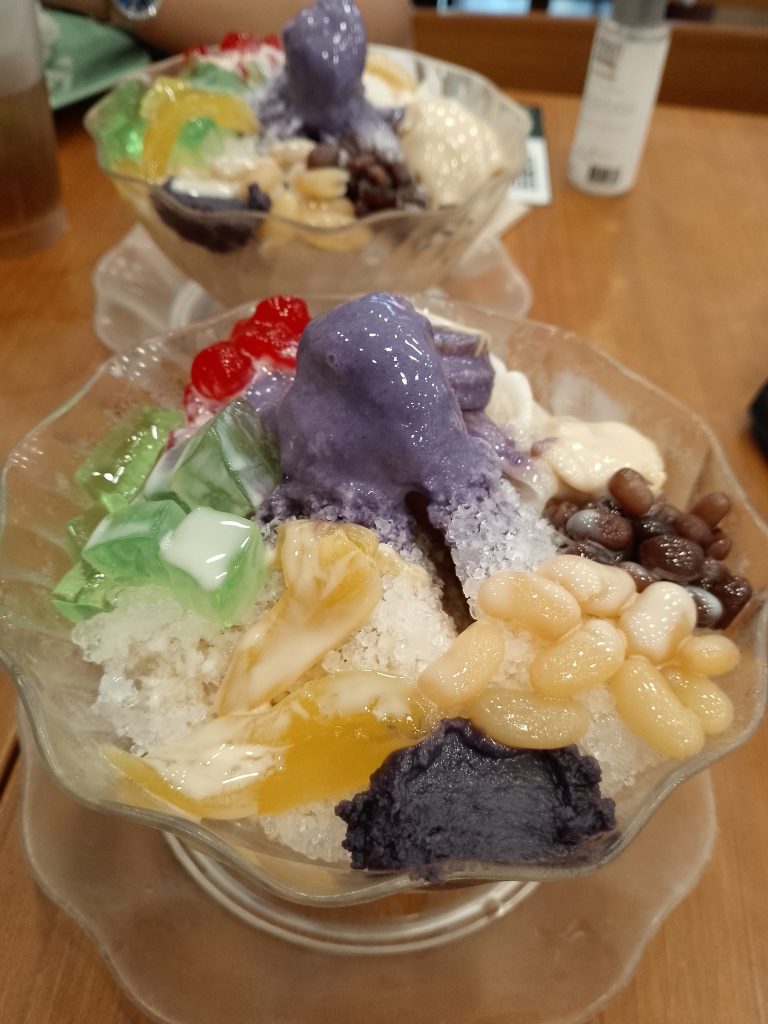
There is no standard recipe, but a typical glass is built in three layers. At the bottom: beans in syrup (munggo, red and white beans, garbanzos, kidney beans), saba and kamote in syrup, sweetened langka, kaong (sugar-palm fruit), nata de coco, macapuno strings, gulaman cubes and sago pearls, sometimes sweet corn. Then the ice, which Ocampo prefers “finely shaved (not crushed)”. On top: leche flan, ube halaya, sometimes ice cream, and pinipig, toasted pounded young rice, for crunch. Evaporated milk goes over the lot; coconut milk and carabao’s milk turn up too.
The relatives are easy to confuse. Mais con yelo is corn, ice, sugar and milk; sources disagree on whether it came before halo-halo or after. Saba con yelo is the same idea with sweetened plantain. Zamboanga’s knickerbocker is a fruit-and-ice-cream sundae cousin. Ginataang halo-halo, despite the name, is a hot coconut-milk dish. And the season follows the weather: PAGASA calls March to May the hot dry season, when temperature and humidity peak; Ocampo calls halo-halo “our iconic summer cooler”.
Two claims about the dish’s rankings are bigger than the facts. CNN did not name halo-halo the world’s best dessert: in 2013 CNN Travel put it on an unranked list of 25 delicious foods for summer. And TasteAtlas, a site built on user ratings, placed halo-halo 43rd on its 2023 list of the world’s 50 best-rated frozen desserts, well behind sorbetes in fifth.
The last stop is Japan. On 31 July 2025 the Philippine Embassy in Tokyo and Ministop Japan marked 30 years of Ministop’s halo-halo, a seasonal convenience-store version of the dish.
Sources
- Ambeth R. Ocampo, “Japanese origins of the Philippine ‘halo-halo’“, Philippine Daily Inquirer, 30 August 2012 (quoting Kiyoshi Osawa, A Japanese in the Philippines, 1981), and “The Iceman Cometh“
- Augusto V. de Viana, “Diversifying Urbanity: The Japanese Commercial Community of Pre World War II Manila“, Sejarah 26 (2017)
- Michelin Guide, “Must-try Filipino desserts and where to enjoy them in the Philippines“, 10 March 2026
- Christine Crisol, “A Halo-Halo Menu”, in Quiapo: Heart of Manila, ed. Fernando N. Zialcita (2006); iDiscover Asia, “Halo-halo“, Quiapo walk; Amy Besa and Romy Dorotan, Memories of Philippine Kitchens, “Origins of Halo-Halo“
- GMA News, “Did you know that halo-halo was inspired by Japan’s kakigori?” (2022)
- City of Bacoor, “Original Digman Halo-Halo” and “BC2 Original Famous Digman Halo-Halo“, 12 March 2026
- Daily Tribune, “The art of keeping it simple“, 3 December 2025, and “Why many Razon’s restaurants?“, 12 December 2025
- The Philippine Star, “The great halo war“, 24 April 2003; Homes.ph, “Three Ingredients, One Legend: Kabigting’s Halo-Halo Puts Arayat on the Culinary Map“, updated 29 May 2026
- PAGASA, “Climate of the Philippines“
- GMA News, “Halo-halo, durian on CNN’s list of top 25 summer delights“, 26 June 2013, and “Sorbetes, Halo-halo among TasteAtlas’ Top 50 Best Frozen Desserts“, 2 June 2023
- Philippine Embassy in Tokyo, “Philippine Embassy, Ministop Japan mark 30 years of halo-halo in Japan“, 1 August 2025; Wikipedia, Halo-halo, Insular Ice Plant and Mais con yelo