
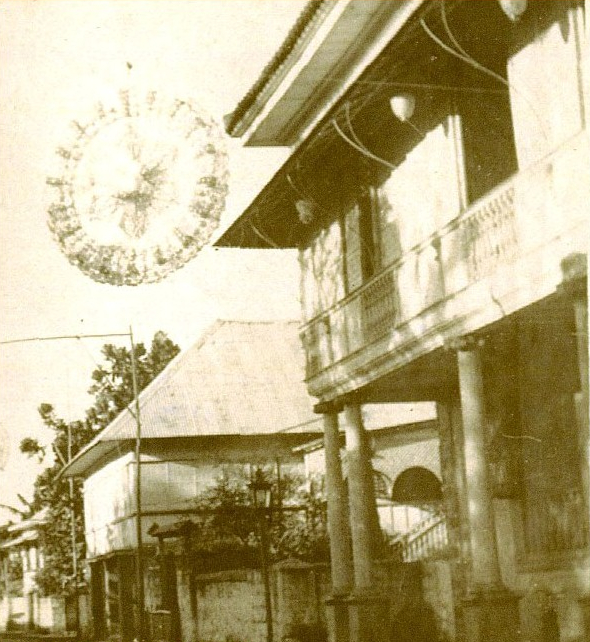
On 26 December 1904, Luther Parker pointed his camera down Consunji Street in San Fernando, Pampanga. The print survives in the National Library of the Philippines. A single round lantern hangs on a wire high above the street, level with the upper floors of the two-storey houses, and it makes their windows look small.
That photograph is four years older than the date Pampanga usually gives for the first star-shaped parol. The Christmas lantern’s history is normally told as the story of one man inventing a shape. Parker’s picture is a reminder that San Fernando was already hanging at least one big lantern over its streets before the star was credited to anyone.
A light for the walk to church
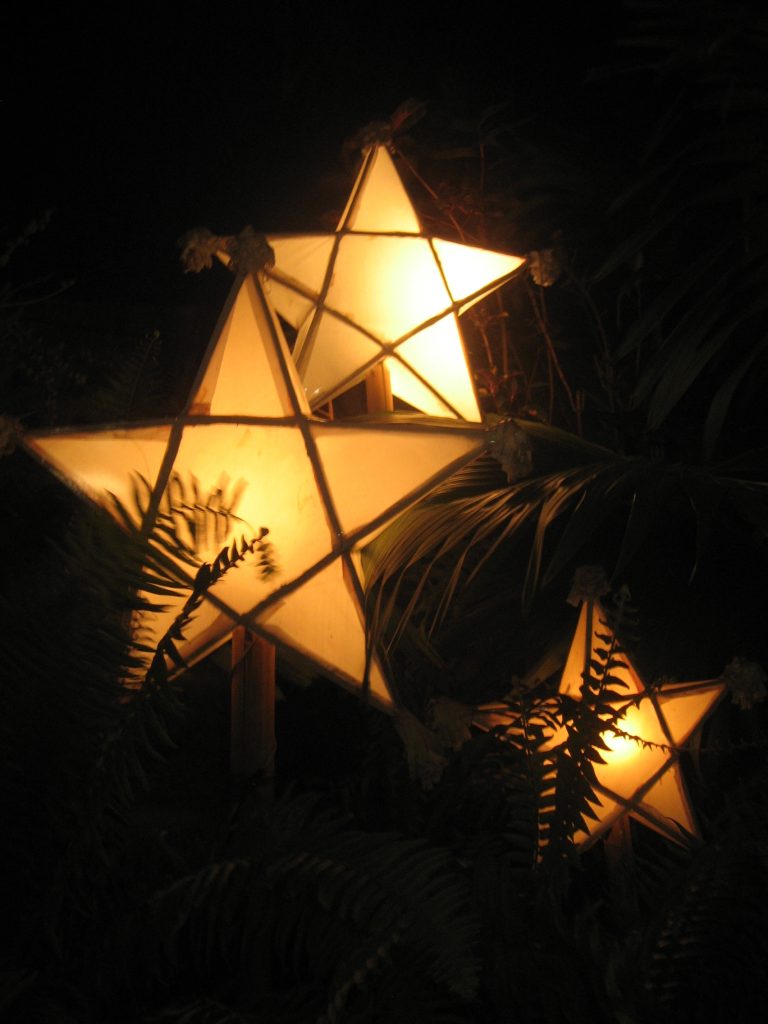
The word is Spanish. Farol means lantern, and Filipinos respelled it parol, or parul in Kapampangan. The older form was simple: a frame of split bamboo, a skin of papel de Japón (thin Japanese paper), and a candle or a kalburo, a carbide lamp, inside.
Its job was practical before it was decorative. The usual explanation ties it to the dawn Masses of the Christmas novena, the Simbang Gabi. A 2003 Philstar piece put it plainly: families walking to church in the dark before a day’s work in the fields were “guided by star-shaped lanterns made of papel de japon … and lighted by candles or kalburo (carbide) lamps.” Encyclopaedic accounts add that the earliest colonial lanterns were plain rectangles of white paper and only settled into the five-pointed star under the Americans. That part rests on thinner evidence, and we have not found a primary source for it.
The star, and the family that claims it
The name attached to the star is Francisco Estanislao, a Pampanga artisan who is said to have built a five-pointed parol of bamboo and Japanese paper. The year is less settled than the name. Rappler, GMA and the Wikipedia entry on the parol all give 1908; Wikipedia is careful to say the date comes from oral accounts. A 2003 Philstar review of an illustrated booklet on the parol says he “reportedly” made it in 1928. Neither date comes with a document. Each rests on what people remember.
Some of that memory is family memory. In 2017 Rappler interviewed Ernesto David Quiwa, then 70, who had been making lanterns in the City of San Fernando for 53 years and who named Estanislao as his great-grandfather. In his telling, the family has been in the business since 1908. His grandfather, Severino David, made the first lantern lit by batteries. In 1957 another relative, Rodolfo David, came up with the rotor.
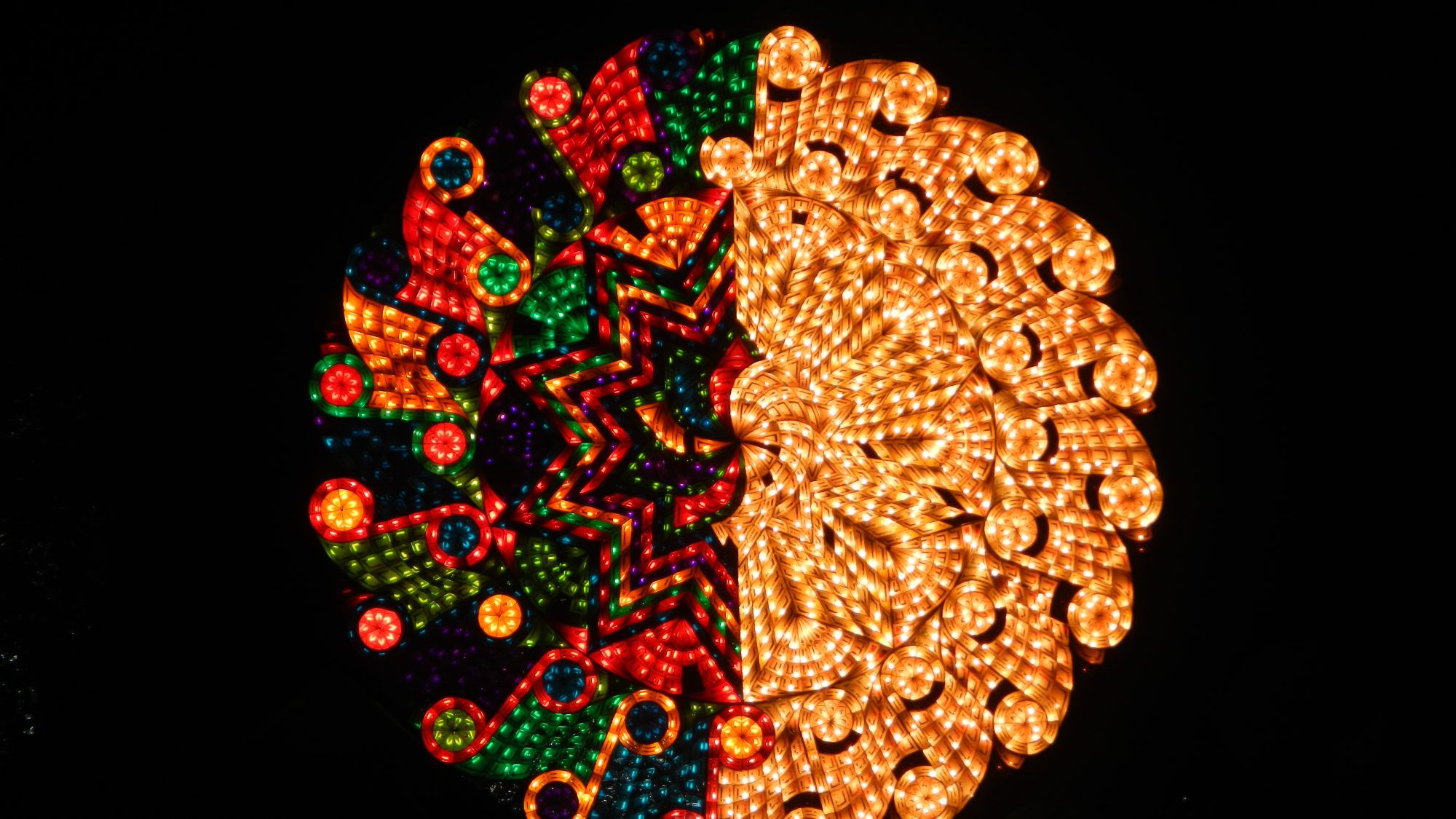
The rotor is the part of a San Fernando lantern you never see. Rappler described rotors as “huge metal cylinders” that let a lantern “dance in different combinations of colors and sounds”, and called the rotor the “brain” of the parol. As the drum turns, contacts on it switch circuits on and off, so the bulbs light in sequence. It is the reason a Pampanga giant lantern seems to move. The electric lanterns that came out of this tradition are known as parul sampernandu, the parol of San Fernando.
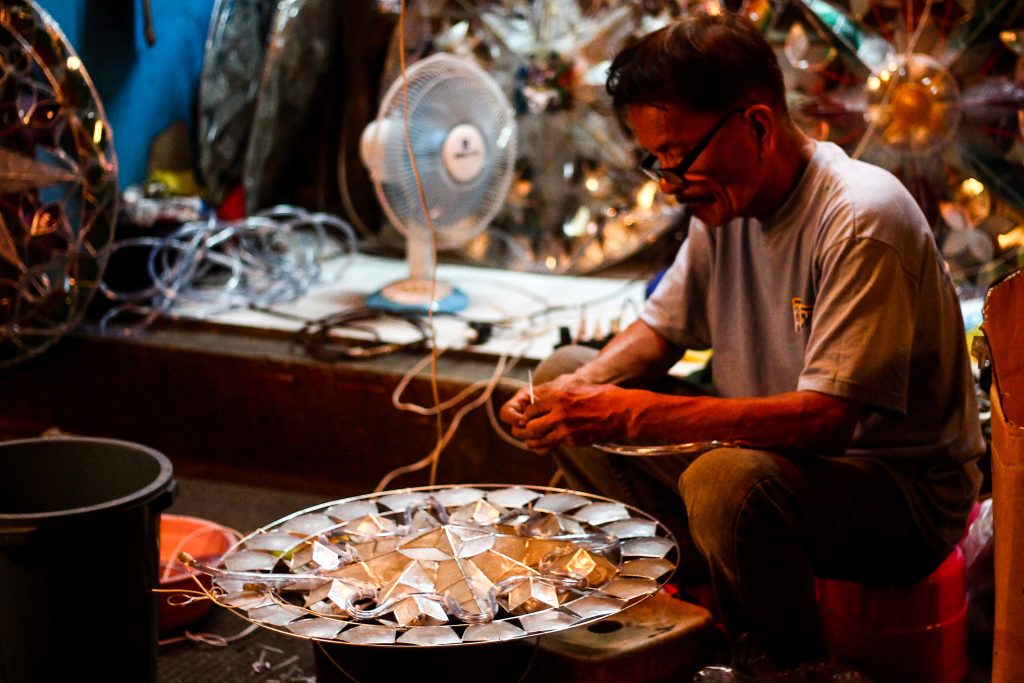
Quiwa did not describe a craft he had been taught. “Walang nagturo sa ‘kin dahil ang paggawa ng parol mula pa sa kanunuhan namin,” he told Rappler: nobody taught him, because lantern-making came down from his forebears. In his 50th year of making parols, Rappler reported, he was named “Golden Man of Parol.”
We would tell it as the story of a lineage rather than an inventor. A star of bamboo and paper is not hard to imagine, and it is unlikely to have occurred to only one person. What San Fernando built, over a century, was an industry, and the knowledge sits with particular families and barangays rather than in an archive.
From a procession to a contest
The Giant Lantern Festival, the Ligligan Parul, grew out of a religious procession called the lubenas. The account usually given, which you will find on Wikipedia and repeated by event listings, runs like this. During the nine-day novena, each barrio carried its own lantern, about two feet across, in procession, and brought it to the town church before the midnight Mass on Christmas Eve. Over the years each barrio pooled its labour into one bigger lantern, and the lanterns turned into a rivalry.
The same history says electricity reached the San Fernando lanterns in 1931, and that the first contest of that kind was staged in honour of President Manuel L. Quezon, who put up the prize. The Wikipedia article that carries this is flagged as needing more citations, and we could not confirm the Quezon story elsewhere, so treat it as the festival’s own telling. The counting is also unsettled. Some say the contest began in 1904, others in 1908; Rappler’s 2017 profile dates it to 1908. When GMA Regional TV covered the December 2025 edition, it called it the 117th. We have not found a document that settles the start year, so treat 1904 and 1908 as competing accounts, and the 1931 electric contest as part of the same unverified telling.
The materials changed faster than the idea did. Japanese paper gave way to coloured plastic, and the lanterns grew to carry thousands of bulbs. GMA described the 2025 entries as “about 20 feet in diameter”, still worked by “traditional rotor systems”. (SunStar’s preview gave a smaller figure, 10 to 12 feet high, so sizes vary by account.) The festival has earned the city its nickname, the Christmas Capital of the Philippines.
The 2025 contest
Ten barangays competed on 13 December 2025 at Robinsons Starmills Pampanga, according to SunStar. Barangay Bulaon won its first championship, with Santo Niño, Dolores and Calulut behind it, as reported by GMA Regional TV. Bulaon’s lantern moved to K-pop songs. Its maker, Mark Flores, gave the kind of advice you hear from a craftsman rather than a tourism office: “Iilan lang ang taong kayang gumawa ng ganitong parol. Kung lantern maker ka na, pangalagaan mo ‘yun. Every year, improve mo ‘yung work mo.” Few people can build a lantern like this, he said. If you are already a lantern maker, look after that, and improve your work every year.
SunStar’s list of the ten 2025 lantern makers includes a Quiwa, for Santa Lucia, and two Davids. We could not confirm whether any of them belong to the family Rappler interviewed, so we do not assume it.
Giant Lantern Festival 2026: what is confirmed
As of 22 November 2026 we have not found an official date for this year’s competition from the City of San Fernando or from the Philippine news outlets that cover it. Several event-listing sites, and a Facebook post by a Pampanga TV station, give 19 December 2026, but we have not found that date from the city itself, and one of the listings names two different venues. We have left that date out until the city confirms it.
For planning, the pattern of recent years helps. The competition has fallen on a Saturday in mid-December: 13 December in 2025, according to SunStar, and 16 December 2023 and 14 December 2024 in Wikipedia’s record of the festival. In 2025 it was held at Robinsons Starmills. Check the City of San Fernando’s official channels before you travel. If you are staying in Metro Manila, our guide to this year’s Christmas light displays covers what is confirmed closer to home.
Sources
- Rappler, Aika Rey, “The golden man of parol“, 21 December 2017
- Philstar (Starweek), “Lanterns & Lace“, 21 December 2003
- GMA News, “What did the earliest parol look like? Kuya Kim sheds light on the origins of the Christmas lantern“
- GMA Regional TV, “Barangay Bulaon wins 117th Giant Lantern Festival in Pampanga“, December 2025
- SunStar Pampanga, “10 barangays to compete in Giant Lantern Festival 2025“
- Wikipedia, Parol and Giant Lantern Festival (consulted 22 November 2026)