
The Department of Trade and Industry publishes the most reliable list of what Filipinos put on the table on Christmas Eve. Its Noche Buena Price Guide for 2024 tracked twelve kinds of product: ham, queso de bola, fruit cocktail, cheese, sandwich spread, all-purpose cream, mayonnaise, pasta, elbow macaroni, salad macaroni, tomato sauce and spaghetti sauce. The 2025 guide, released in November 2025, listed 256 items in 14 categories, with nata de coco and kaong added as categories for the first time. As of 22 November 2026 we had not found a 2026 edition, so the prices in this piece are the 2025 figures.
The list is meant for price-checking, but it also works as a menu. There is a ham and a ball of Dutch cheese, inherited through Spain. There is a fruit salad that comes out of American cans. And there is a spaghetti that took most of the 20th century to turn sweet. None of the four is native, and all four have become hard to leave off the table. This is how each of them got there, and how much of that history is actually on record.
A meal after midnight
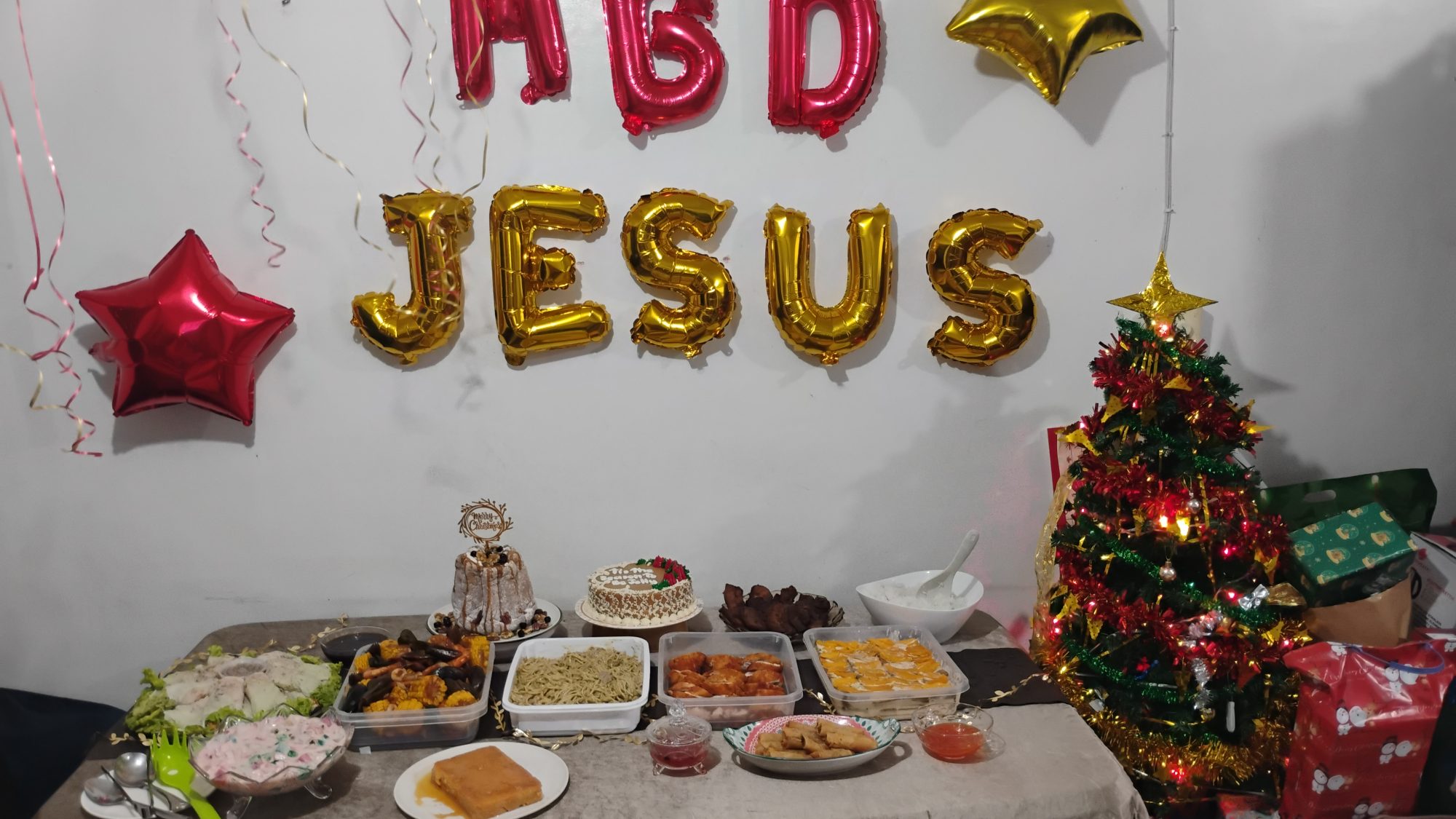
Doreen G. Fernandez, the food historian, defined the occasion in an essay collected in Tikim (1994); we quote it here and below from the reprint Positively Filipino published in 2018. Noche Buena, “night of goodness”, is “not really just Christmas Eve, to which the term refers, but also and specifically the meal shared by the family after the midnight mass.” It was also called media noche. Her mother remembered that no one ate until after the Mass, since people fasted, especially from meat, before the feast. It was a meal for family rather than guests, coming at the end of a December of church-going that, for many households, starts with Simbang Gabi.
Her explanation for the Spanish dishes is short: “Since Christmas as feast came to us with Christianization and through the Spaniards, many of the food components are Spanish: jamon, relleno, galantina, chocolate, ensaimada, even the apples, oranges, grapes, turrones, and castanas.” She added that these were “sought even in hard times”, when anything imported was beyond most budgets, because they had become symbols of the holiday.
Ham, in a cloth sack
Fernandez’s own answer to the question “what is your Christmas meal?” was “baked, sugared ham”: “The jamon China or jamon en funda (it came in cloth sacks) which had been cooked in beer, baked with cloves, and glazed with sugar.” Several traditions are already mixed in that sentence. Jamón is Spanish, funda is the sack it was sold in, and the jamón China was a Chinese-style cured leg.
Cora Alvina, an anthropology graduate who directs the Museo ng Kaalamáng Katutubò, traced the same line in a talk reported by the Philippine Daily Inquirer in December 2025: jamón runs “from homemade de funda to imported serrano or ibérico”, and the American period added Virginia ham. One of the families in Fernandez’s essay, from Malolos, served a Smithfield ham from the United States, “although there might also be Hoc Shiu (jamon China).”
The Chinese-style ham survives in Quiapo. GMA News reported in 2014 that two shops there, Excelente Ham and New City Grocery, still made ham from recipes handed down through their families. Excelente’s version, by that account, was saltier than the sweet supermarket kind and came in a red box with its pineapple glaze packed separately. In a 2024 essay in The Philippine Star, a writer remembered the Quiapo ham that became a family Christmas fixture: “Never mind if the queue at the ham store snaked through the alleys.” The supermarket hams are the ones the DTI price-checks: in 2025 a 500-gram CDO American Style Ham was rolled back to ₱170.
A Dutch cheese in red wax
Queso de bola is Edam, the cheese of the Dutch town of the same name. The Spanish name just describes it: queso, cheese, and bola, ball. How it reached the Philippines is not documented. The food historian Felice Prudente Sta. Maria told The Philippine Star in 2015 that it arrived “as a maritime staple for officers in galleons”, according to a Vice report that quotes her. The same report notes that the Dutch, at war with Spain in the mid-1600s, raided Spanish posts around the islands and traded quietly with Filipinos. Both are plausible routes. Neither has a paper trail that we found.
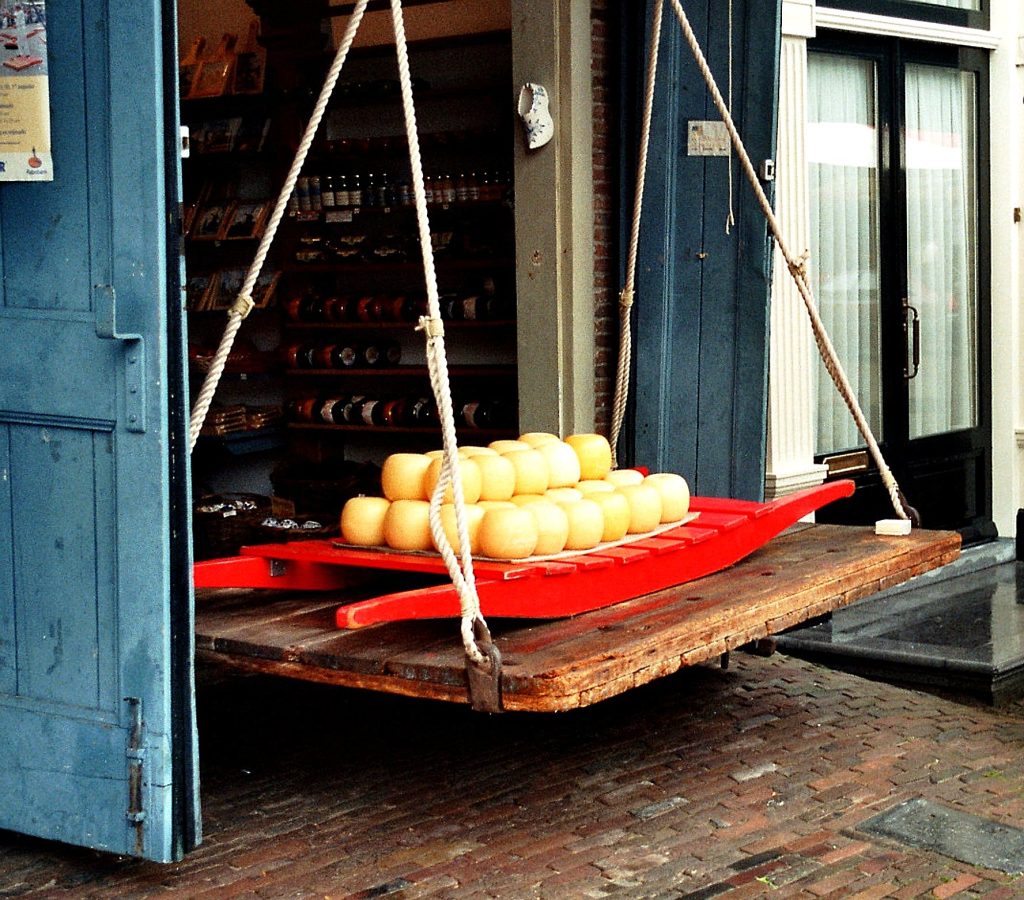
Why it became a Christmas cheese is easier to explain. Edam was prized for keeping well on long voyages, an Inquirer feature notes, and in the Philippines its rarity and cost tied it to special occasions. Folk belief adds that round things stand for money and red for luck. The same December 2025 feature sums up the modern situation: in the writer’s mother’s house “the table is not complete without a little queso de bola, even if not that many people actually eat it.” Much of it is now produced locally. A 500-gram Danes Queso de Bola was listed at ₱300 in the 2025 price guide.
Fruit from a can
The Filipino Christmas fruit salad is canned fruit cocktail folded into cream and condensed milk, and every account we read places it in the American period. Alvina lists it with roast turkey, Russian salad and fruitcake as an American influence. Elena Peña of The Freeman wrote in 2020 that it “is likely not a Filipino original”, noting that early Filipinos could not have made nata de coco or sourced it from elsewhere.
The food writer Connie Veneracion goes further. She argues that the dish is an adaptation of American ambrosia salad. She cites Edith Moses, wife of the American commissioner Bernard Moses, whose Unofficial Letters of an Official’s Wife preferred canned food to local produce, including canned fruit over fresh mangoes. Veneracion places the salad’s arrival in ordinary homes after the Second World War, when American goods were still too dear for daily use and were kept for special occasions. We have not checked the Moses letters ourselves, so take that link as hers.
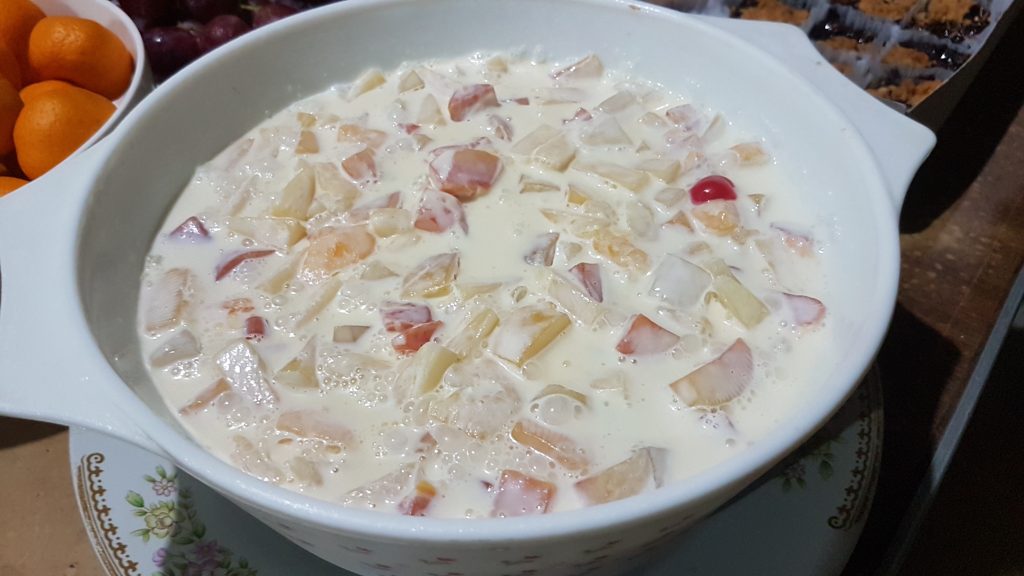
What follows is our interpretation, not a sourced claim: in a country with mangoes, papaya and pineapple in the markets, the canned salad was never about fruit. The tin was the luxury. That would explain why fruit cocktail and all-purpose cream are on the 2024 government price list and fresh fruit is not.
Spaghetti, sweetened by degrees
Spaghetti is the youngest of the four, and its history has the most dates. In What Recipes Don’t Tell, the sequel to her When Mangoes & Olives Met at the Philippine Table, Sta. Maria traces it to Manila in the 1920s, when it was served at places like the Santa Ana Cabaret, as Reggie Aspiras summarised the two books in the Inquirer in January 2026. By the 1930s, imported pasta and canned tomatoes had brought it into homes. A 1937 “Spaghetti Italian” from a Philippine Manufacturing Company booklet, reprinted in Mangoes & Olives, calls for bacon, tomato pulp, stock, canned mushrooms and a roux made with Star Margarine. It is not sweet.
The sugar probably came by substitution. Tomato ketchup reached the Philippines after the Spanish–American War, according to the US National Park Service, and in the 1930s the food chemist Maria Orosa, then at the Bureau of Plant Industry, made a ketchup from bananas instead. Over the following decades, as Aspiras sums up the shift, cooks swapped tomato pulp for banana ketchup and bacon for hot dogs. Her guess that the sauce turned sweet as children became the stars of celebrations is, she writes, one she still has to confirm with Sta. Maria. An ANCX essayist dates his own first sweet spaghetti to American military ration cans in 1969, and gives 1979 as the year Jollibee put spaghetti on its menu. Those are one writer’s recollections, but they help explain why the dish now reads as children’s party food.
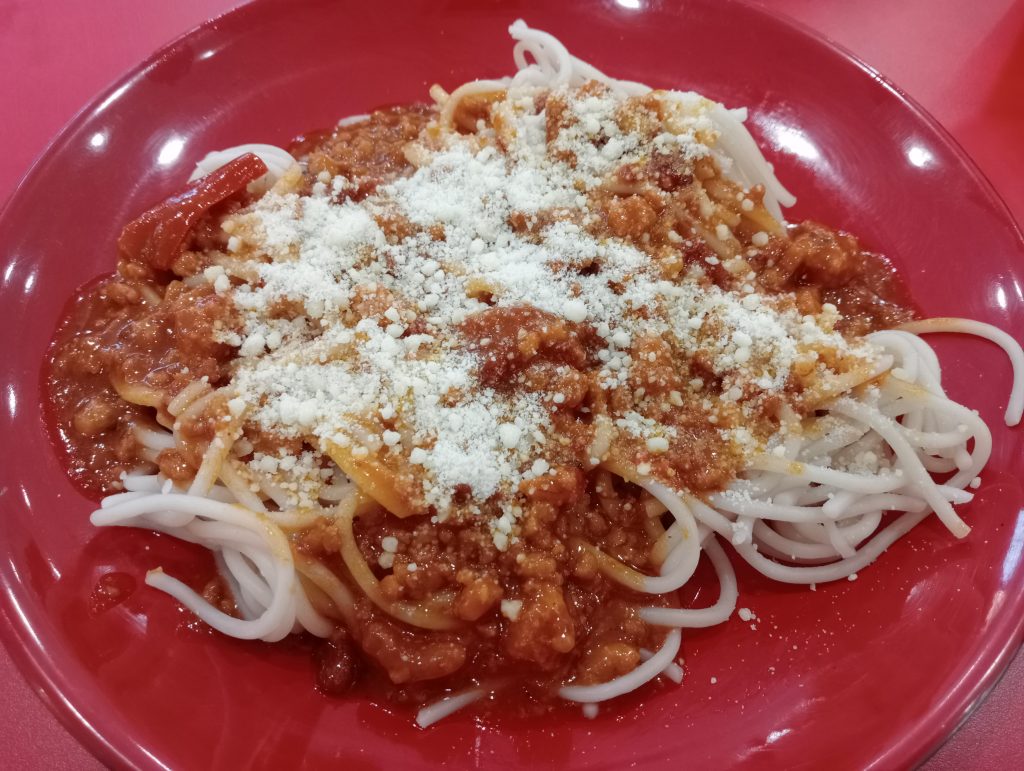
When it joined Noche Buena is harder to pin down. In Fernandez’s 1994 essay, as reprinted, she collected Christmas menus from Negros, Cebu, Bohol, Pampanga, Bulacan, Albay, Capiz and Manila, and none of them mentions spaghetti. Thirty years later, the DTI tracks pasta and spaghetti sauce as Noche Buena staples. That gap does not give us a date, but it does suggest that spaghetti is a recent arrival on a table that much of the country thinks of as traditional.
What the price guide leaves out
The DTI list only covers what comes in a can, a jar or a waxed ball, so it leaves out the oldest part of the meal. Fernandez argued that Christmas was “also a feast built on an older celebration – harvest, probably”, and that the constant across her menus was rice: suman, ibus, puto, and the bibingka and puto bumbong sold outside churches. The poor might have only the suman, she wrote, and the rich might load the table with Spanish and American dishes, “but they too, retain the rice.”
The 2024 guide stayed in effect until 31 December, so it covered the New Year’s Eve media noche as well. If the 2026 edition follows the same pattern, it will be posted on the DTI website and its regional pages. Check the date on it before you shop.
Sources
- Doreen G. Fernandez, “Noche Buena“, from Tikim: Essays on Philippine Food and Culture (Anvil, 1994), reprinted by Positively Filipino, 19 December 2018
- ABS-CBN News, “DTI releases 2024 Christmas Noche Buena price guide“, 17 November 2024; Daily Tribune, “DTI releases 2025 Noche Buena price guide, secures rollbacks on select items“, 10 November 2025; BusinessWorld, “Noche Buena 2025 price guide shows price hikes for 95 items“
- Philippine Daily Inquirer via Asia News Network, “Dissecting the Noche Buena—the Philippines’ Christmas Eve feast“, 22 December 2025, and “‘Queso de bola’: The symbol of a Filipino Christmas“, 9 December 2025
- GMA News, “What’s cooking for Christmas: Chinese ham and chestnuts“, 13 November 2014; The Philippine Star, “The story of our Christmas ham“, 27 December 2024
- Vice, “How Dutch Edam Became a Christmas Tradition in the Philippines” (quoting Felice Prudente Sta. Maria in The Philippine Star, 2015)
- Connie Veneracion, “Ambrosia, the colonial root of Filipino fruit salad“, Umami Days; Elena Peña, “Fruit Salad“, The Freeman, 18 December 2020
- Reggie Aspiras, “A lasting gift to Filipino food culture“, Philippine Daily Inquirer via Asia News Network, 16 January 2026 (on Felice Prudente Sta. Maria, When Mangoes & Olives Met at the Philippine Table and What Recipes Don’t Tell)
- US National Park Service, “Maria Ylagan Orosa“; ANCX, “The strange tale of how the sweet spaghetti became a Filipino cultural icon“, 10 May 2020